OK, what is it with "conformant" for products that conform to a standard? What's wrong with "conforming"? If something conforms, it is conforming (if something deforms, it is deforming (the deforming pressures...not deformant pressures).
I've had to use that foul nonword in various documents and web pages because the organization for whom I'm producing these things has ignored my argument that, since conformant wasn't in any actual dictionary, it didn't count as an actual word. At about that time, interestingly, it showed up in Wiktionary). Apparently the argument is that, because it appears in a zillion pages on the web, it is now a real word. Dagnabbit, it's just a lazy back-formation from "conformance". Nerds.
Friday, March 27, 2009

Friday, December 12, 2008
Jules Verne and the Internet
I just read the intriguing short story "In the Year 2889," written by Jules Verne in 1891. It follows a day in the life of a news mogul 1000 years in Verne's future, and it sounds for all the world to me as if he's describing the World Wide Web...a hundred years before Al Gore invented it!
This is a lovely example of how a creative writer can take an infant technology or two (the phonograph had become publicly available really only in the previous year or so, the telephone had become available in only a few localities in the previous decade) and extrapolate some fantastically prescient uses.
Enjoy these excerpts or read the whole thing courtesy of Project Gutenberg):
Every one is familiar with Fritz Napoleon Smith's system--a system made
possible by the enormous development of telephony during the last
hundred years. Instead of being printed, the Earth Chronicle is every
morning spoken to subscribers, who, in interesting conversations with
reporters, statesmen, and scientists, learn the news of the day.
Furthermore, each subscriber owns a phonograph, and to this instrument
he leaves the task of gathering the news whenever he happens not to be
in a mood to listen directly himself. As for purchasers of single
copies, they can at a very trifling cost learn all that is in the paper
of the day at any of the innumerable phonographs set up nearly
everywhere.
....
The first thing that Mr. Smith does is to
connect his phonotelephote, the wires of which communicate with his
Paris mansion. The telephote! Here is another of the great triumphs of
science in our time. The transmission of speech is an old story; the
transmission of images by means of sensitive mirrors connected by wires
is a thing but of yesterday. A valuable invention indeed, and Mr. Smith
this morning was not niggard of blessings for the inventor, when by its
aid he was able distinctly to see his wife notwithstanding the distance
that separated him from her.
.....
In one corner is a telephone, through which
a hundred Earth Chronicle _littérateurs_ in turn recount to the public
in daily installments a hundred novels.
......
Mr. Smith continues his round and enters the reporters' hall. Here 1500
reporters, in their respective places, facing an equal number of
telephones, are communicating to the subscribers the news of the world
as gathered during the night. The organization of this matchless service
has often been described. Besides his telephone, each reporter, as the
reader is aware, has in front of him a set of commutators, which enable
him to communicate with any desired telephotic line. Thus the
subscribers not only hear the news but see the occurrences. When an
incident is described that is already past, photographs of its main
features are transmitted with the narrative. And there is no confusion
withal. The reporters' items, just like the different stories and all
the other component parts of the journal, are classified automatically
according to an ingenious system, and reach the hearer in due
succession. Furthermore, the hearers are free to listen only to what
specially concerns them. They may at pleasure give attention to one
editor and refuse it to another.
This is a lovely example of how a creative writer can take an infant technology or two (the phonograph had become publicly available really only in the previous year or so, the telephone had become available in only a few localities in the previous decade) and extrapolate some fantastically prescient uses.
Enjoy these excerpts or read the whole thing courtesy of Project Gutenberg):
Every one is familiar with Fritz Napoleon Smith's system--a system made
possible by the enormous development of telephony during the last
hundred years. Instead of being printed, the Earth Chronicle is every
morning spoken to subscribers, who, in interesting conversations with
reporters, statesmen, and scientists, learn the news of the day.
Furthermore, each subscriber owns a phonograph, and to this instrument
he leaves the task of gathering the news whenever he happens not to be
in a mood to listen directly himself. As for purchasers of single
copies, they can at a very trifling cost learn all that is in the paper
of the day at any of the innumerable phonographs set up nearly
everywhere.
....
The first thing that Mr. Smith does is to
connect his phonotelephote, the wires of which communicate with his
Paris mansion. The telephote! Here is another of the great triumphs of
science in our time. The transmission of speech is an old story; the
transmission of images by means of sensitive mirrors connected by wires
is a thing but of yesterday. A valuable invention indeed, and Mr. Smith
this morning was not niggard of blessings for the inventor, when by its
aid he was able distinctly to see his wife notwithstanding the distance
that separated him from her.
.....
In one corner is a telephone, through which
a hundred Earth Chronicle _littérateurs_ in turn recount to the public
in daily installments a hundred novels.
......
Mr. Smith continues his round and enters the reporters' hall. Here 1500
reporters, in their respective places, facing an equal number of
telephones, are communicating to the subscribers the news of the world
as gathered during the night. The organization of this matchless service
has often been described. Besides his telephone, each reporter, as the
reader is aware, has in front of him a set of commutators, which enable
him to communicate with any desired telephotic line. Thus the
subscribers not only hear the news but see the occurrences. When an
incident is described that is already past, photographs of its main
features are transmitted with the narrative. And there is no confusion
withal. The reporters' items, just like the different stories and all
the other component parts of the journal, are classified automatically
according to an ingenious system, and reach the hearer in due
succession. Furthermore, the hearers are free to listen only to what
specially concerns them. They may at pleasure give attention to one
editor and refuse it to another.
Tuesday, October 14, 2008
More Misheard English and Folk Songs
Here's another tricky phrase: "Dog eat dog," usually used in "It's a dog-eat-dog world," meaning that the competition is fierce and only the strongest and fittest survive. Thanks to Lucy and Walter, we've realized that the pronunciation sounds almost exactly like "doggy dog." "It's a doggy dog world" doesn't convey any meaning at all, really, but we can understand how someone might hear it that way.
Which reminds me of a folk tune, Sarah the Whale. (For another intriguing exploration of language, left as an exercise for the reader, do a web search for "Sara whale teeth miles" (some of the more-common words) and see how many variants there are.) One of the stanzas as I learned it is:
I was surprised about 4 years ago, when perusing some of the lyric variants, to discover that one site spelled it out as "and things to fierce dimension," I suppose along the lines of "to [a] great degree". Once again, "to mention" and "dimension" can sound amazingly alike, especially when sung.
There are plenty of sites (and books) about misheard lyrics, as discussed in my 2005 post, The Lady Mondegreen Sings Christmas Carols.
Which reminds me of a folk tune, Sarah the Whale. (For another intriguing exploration of language, left as an exercise for the reader, do a web search for "Sara whale teeth miles" (some of the more-common words) and see how many variants there are.) One of the stanzas as I learned it is:
When she smiles, she just shows teeth for miles and miles,
and tonsils, and spare ribs, and things too fierce to mention.
I was surprised about 4 years ago, when perusing some of the lyric variants, to discover that one site spelled it out as "and things to fierce dimension," I suppose along the lines of "to [a] great degree". Once again, "to mention" and "dimension" can sound amazingly alike, especially when sung.
There are plenty of sites (and books) about misheard lyrics, as discussed in my 2005 post, The Lady Mondegreen Sings Christmas Carols.
Saturday, August 02, 2008
Misheard English--Intensive Purposes
Have you heard this one? "...for all intensive purposes..."
It's certainly an interesting, and unintentional, twist on the phrase "for all intents and purposes." And, apparently, not an uncommon mistake. For more discussions:
It's certainly an interesting, and unintentional, twist on the phrase "for all intents and purposes." And, apparently, not an uncommon mistake. For more discussions:
Tuesday, June 10, 2008
More Bad Translations
I've just added another interesting example of "Engrish" to Why Copy Editors Aren't Useless.
Tuesday, April 29, 2008
The Cambist and Lord Iron
If you want to read a good story, by a fellow Clarion Wester, nominated for a Hugo, follow this link. It's from the anthology Logorrhea, where each writer had to choose from a list of unusual words and write a story about it. All good stories, too, but this one's particularly good. IMHO.


Friday, January 11, 2008
Vocabulary test
Thanks to reading another dog-agility blogger's site, I spent a minute on this quickie test for bragging rights:
And, for Christmas, friends gave me The Gilded Tongue, a real treat of a book. Not only is it one of my favorite topics (Words words words!), but its cover is purple. What more could one ask?!
| Your Vocabulary Score: A |
 Congratulations on your multifarious vocabulary! You must be quite an erudite person. |
And, for Christmas, friends gave me The Gilded Tongue, a real treat of a book. Not only is it one of my favorite topics (Words words words!), but its cover is purple. What more could one ask?!
Monday, September 10, 2007
What is a Babylon candle?
Saw Stardust yesterday. In it, Babylon candles play an important role. These candles, when lit, whisk the bearer instantly to wherever he wants to go--which isn't explained outright in the film, merely demonstrated (a good example of showing, not telling, BTW). However, given that there's no explanation, I rather assumed that Babylon candles were an established if perhaps obscure fantasy trope--like ten-league boots. Why "Babylon"? No idea. Didn't think too hard about it.
My sister, however, just figured it out: Remember the old nursery rhyme?
My sister, however, just figured it out: Remember the old nursery rhyme?
How many miles to Babylon?
Three score miles and ten.
Can I get there by candlelight?
Yes, and back again.
Monday, August 27, 2007
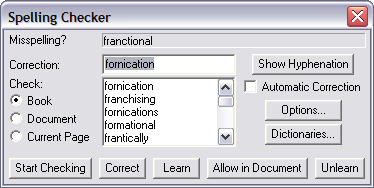
Spell-Checker Joy
I usually rail against spell-checking software because it's so easy to rely on it and thereby miss blatant errors. (For example, my eyeballs just caught in my Taj MuttHall blog the typo "...right of the bat," which is a bit different from "right off the bat.") However, sometimes they make the effort of using them completely worthwhile. Like this example from a coworker:
Saturday, July 28, 2007
Plug for a Great Book (Series?)
I'm trying to decide whether I'm more excited about the next Bourne movie opening in a week or so, or about the second book of Daniel Abraham's The Long Price Quartet coming out in September. I recently read A Shadow in Summer (I was trying to wait until the whole set came out, but the reviews were too good and I've been waiting for 8 years since reading a short story that became part of this book), and it was a stay-up-all-nighter for me. (Which, incidentally, the Harry Potter books haven't been.) It's a wonderful, imaginative fantasy. A Betrayal in Winter will be out in September, and for those of you near Albuquerque, he'll be doing a signing at a Barnes and Noble on September 8.
His web site is here: danielabraham.com/, and you can actually read the first couple of chapters of Winter here.
Full disclosure: I know Daniel and attended the Clarion West workshop with him. That's probably the only reason that I know about his work, but he's been doing very well, selling in good markets, has already won an award for one of his short stories. And, dammit, it's a great book! FWIW, George R.R. Martin likes his stuff, too. :-)
His web site is here: danielabraham.com/, and you can actually read the first couple of chapters of Winter here.
Full disclosure: I know Daniel and attended the Clarion West workshop with him. That's probably the only reason that I know about his work, but he's been doing very well, selling in good markets, has already won an award for one of his short stories. And, dammit, it's a great book! FWIW, George R.R. Martin likes his stuff, too. :-)
Thursday, July 19, 2007
Opening Lines
My fiction-writing has been on hiatus for some time, since I realized that I was getting more out of doing dog agility (in many ways but not all ways) than writing. I have a deep passion for writing that I keep thinking some day will resurface. I try hard to keep it suppressed because I just don't have time for that kind of passion with everything else in my life. ...Boy, that sounds crappy.
OK, I mention this only because a fellow Clarion-Wester (1998) posted the openings to his sold novels. That was in response to Tim Pratt's similar post.
Which got me thinking about my own writing, which I haven't decided whether 'tis good or bad (the thinking, not the writing).
I've never written a novel (well...not worth ever trying to send out), but I have sold two short stories, and one that got accepted by one editor and rejected by the next before it was published.
Here are the openings:
And then, just for fun because I can, here are the openings to the stories I wrote at Clarion in June/July 1998:
OK, I mention this only because a fellow Clarion-Wester (1998) posted the openings to his sold novels. That was in response to Tim Pratt's similar post.
Which got me thinking about my own writing, which I haven't decided whether 'tis good or bad (the thinking, not the writing).
I've never written a novel (well...not worth ever trying to send out), but I have sold two short stories, and one that got accepted by one editor and rejected by the next before it was published.
Here are the openings:
She couldn't find the good bluestone teapot. How she hungered for a simple sit-down tea, with fresh-baked crumpets slathered in strawberry jam, crusts broken open to moist, buttermilky interiors. If the muffin man came by, she could get them, still warm, from under the linen towel on his tray. (James James Morrison's Mother, written 1994)
He rode into New Jerusalem on the back of a donkey. Beneath the rising Florida sun, he rode to meet his destiny, and they laid down palm fronds before him to cover the oil-splattered pavement. (Passover, written 1988)
"Here's the junction," said the driver in German, pulling his vehicle over to the boulder-strewn shoulder with a tight, apologetic smile. "Sorry I can't drive you up myself, but the road is very bad from here on."
Sure it is, thought Rolf. (Time Enough, written 1990?)
And then, just for fun because I can, here are the openings to the stories I wrote at Clarion in June/July 1998:
Nan turned the pickup down Hicks Road, eyes aching from the slow, careful drive back from Richmond. She pulled wide around the corner to avoid the top of the old hemlock sprawled across the intersection from the Smythes’ yard, more of Bella’s random litter. She and Sarah Smythe had built a treehouse in that tree in fifth grade and had watched the Millennium fireworks from it in seventh. (Disaster Area)
My life has not been ordinary. I have left my footprints in a thousand more places across the face of the earth than most women; I have lunched with princes and artists and whores; I have exposed myself to temperatures and heights and depths far beyond those that most people can even imagine. Life is uncertain; that is not a new idea but rings true for me and so risk is my chosen companion. But alone of all my experiences, only one has come into my life with the grandeur and portent of a comet, lingering briefly but with such silent intensity that one cannot but assume that one’s life has been altered forever by its passing. And that one thing was Jo. (Jo)
The icy spring melt had swollen Sentinel Creek to a roaring insanity. As it plunged from the high Sierras down its ancient granite defile towards Yosemite Valley, it smashed itself into a continuous spray that rained down on the steep trail winding uphill alongside it. (Untitled)
[Including the first 3 paragraphs of this story, because the first line isn't what makes the opening work.]
A woman sits in a public place.
You see how little this tells us? There is no scene, other than public, no time, no season. She could be anywhere. She could be doing anything. There are so many options, so many ways to create a story with an ending that will fulfill us. Perhaps she is a young woman, in a park, pretending to read, waiting for her lover.
Or she could be an old woman, hands quivering, dressed in black, sitting outside the government building, waiting for the Public Assistant, who never comes. When businessmen walk by without looking at her, she calls out to them, "Calzone! Your mother makes Calzone!" And she spits. (Montage)
Jazz, she the woman. She preen afore the the glass-alas, her braid so long so gold, her face so smooth so pale. "Lower," say the Jazz. Glass-alas it lean from wall, it show her naked tum so flat. She thrust her shoulders back, she smile; boobs white, so firm so high where Mar-man, he like put his hands--she almost feel they heat. He young, her Mar, he twenty-five; she love that touch, that voice a-song when Mar he make rejazz for her, for Jazz. He young, that Mar, and so must she, and so must she. (DeLeon Redux)
The heat consumed Davidson's energy with uncaring voraciousness. Somewhere across the transformed Redknot Forest waited the conditioned air of base camp, the only human outpost on this planet's only continent. Somewhere behind him, hours or weeks--he couldn't recall anymore--lay the charred and shattered remains of the recon hover, half-buried by gottem vines before he had even staggered away into Primara's newborn jungle, following Reuben. (Reuben in a White-Hot Heat)
Ariella plunged her sinuous delicate white fingers into the delectably tempting display of bananas. Her mouth went dry with longing. Each fruit's ready hardness welcomed her touch. Perfect for another romantic breakfast with Pierre, she thought, her expressing turning blasé. Quickly her delicately muscled arm grabbed and thrust a bunch into her grocery basket. (Forbidden Pleasure)
When they hit the mine, Artie had just swerved to keep from running over a body half-tumbled from the undergrowth. As the explosion lifted the rear of the jeep up and over and dumped him beneath it, his gorge was just rising from the unexpected sight of a green-clad corpse. (Anything But the Brain)
Marla sat at her makeshift desk, staring at a pile of sample llama-hide pot holders instead of at the stack of unpaid bills next to them or at her nearly blank computer screen. A thin stream of mulberry incense wafted across her vision. Maybe if she had taken the pot holders down to Gloriosa’s Miscellany Mart last Saturday she could have sold enough to at least pay the rent. (Why Nothing Ever Gets Done Around Here)
Monday, June 25, 2007
Does She or Doesn't She?
In today's lesson on the complete clarity of the English language, I received the following email from a friend:
"On Late Night with David Letterman, Soja's daughter Pico appears to do dock diving."
Perhaps she's the canine incarnation of Uri Geller, fooling a gullible audience into believing she's doing astonishing feats when in fact she's lounging on a couch in Peoria, eating popcorn.
Perhaps she meant:
"On Late Night with David Letterman, Soja's daughter Pico appears and does dock diving."
"On Late Night with David Letterman, Soja's daughter Pico appears to do dock diving."
- Soja is a dog. So is Pico.
- Is Pico really doing dock diving, or does she just appear to do dock diving?
Perhaps she's the canine incarnation of Uri Geller, fooling a gullible audience into believing she's doing astonishing feats when in fact she's lounging on a couch in Peoria, eating popcorn.
Perhaps she meant:
"On Late Night with David Letterman, Soja's daughter Pico appears and does dock diving."
Monday, May 14, 2007
Wednesday, April 25, 2007
Crosswords Updated
Reading back through some old posts, I comment on how I could usually complete the SJ Mercury daily crossword in 10-15 minutes. I must be getting better, because now it's typically 7 to 9 minutes. This year, I have twice broken the 5 minute barrier, getting them done in 4 minutes and some large number of seconds. Very exciting. But those were the Monday or Tuesday ones, which I think tend to be easier.
Although, interestingly, Saturday's are often easier for me than some other days'. They look hard because they have lots of long words and phrases, but in face those long ones are crossed by much shorter, usually fairly easy, words, and the long ones themselves are not too challenging.
For many years, I just did crosswords without realizing that there was a pattern, until somewhere I read or heard that the New York Times puzzle starts out easiest on Monday and then gets harder through the week until the Sunday brain smasher. I started paying attention to the Merc's puzzle, and indeed in general they're easier earlier on and take longer to complete as the week goes on; Saturday's typically has the long words/phrases; and Sunday's--well, they resort to socking us with the NY Times Sunday puzzle.
And now...back to dogs. Or work. Or both.
-------
Update October 4, 2007: Being the obsessive data-gathering sort that I am, for the last 5 months I've tracked how long it took me to do the puzzles. Apparently my subjective impressions are completely unreliable. (Wait--don't quote me on that--) Each day of the week averages about 9 minutes for me; Saturday averages about 11 minutes. I hit 4:33 this last week on one puzzle--woo hoo. And I attempted the Sunday New York times puzzler, also, and did it in what must be (for me) a new record time of an hour, looking up only six words. But these successes don't pay quite as well as understanding (and writing about) the difference between blitting and alpha blending. ...sigh...
Although, interestingly, Saturday's are often easier for me than some other days'. They look hard because they have lots of long words and phrases, but in face those long ones are crossed by much shorter, usually fairly easy, words, and the long ones themselves are not too challenging.
For many years, I just did crosswords without realizing that there was a pattern, until somewhere I read or heard that the New York Times puzzle starts out easiest on Monday and then gets harder through the week until the Sunday brain smasher. I started paying attention to the Merc's puzzle, and indeed in general they're easier earlier on and take longer to complete as the week goes on; Saturday's typically has the long words/phrases; and Sunday's--well, they resort to socking us with the NY Times Sunday puzzle.
And now...back to dogs. Or work. Or both.
-------
Update October 4, 2007: Being the obsessive data-gathering sort that I am, for the last 5 months I've tracked how long it took me to do the puzzles. Apparently my subjective impressions are completely unreliable. (Wait--don't quote me on that--) Each day of the week averages about 9 minutes for me; Saturday averages about 11 minutes. I hit 4:33 this last week on one puzzle--woo hoo. And I attempted the Sunday New York times puzzler, also, and did it in what must be (for me) a new record time of an hour, looking up only six words. But these successes don't pay quite as well as understanding (and writing about) the difference between blitting and alpha blending. ...sigh...
Tuesday, January 23, 2007
Grammar Quiz
I don't know how long these things stick around on gotoquiz.com, but for now, you can test your grammar here.
Thursday, January 18, 2007
False Friends
A short article in Uncle John's Curiously Compelling Bathroom Reader reminded me about false friends, which are words in one language that resemble words in another language but that have different meanings.
For example, "kill" in mideastern languages (not sure which) means "friend"; "pies" in Polish means "dog"; "king" in Estonian means "shoe."
For more information, Wikipedia has a fine article about the subject and also an extremely extensive list of false friends.
For example, "kill" in mideastern languages (not sure which) means "friend"; "pies" in Polish means "dog"; "king" in Estonian means "shoe."
For more information, Wikipedia has a fine article about the subject and also an extremely extensive list of false friends.
Monday, January 15, 2007
To Of or Not To Of
A fan writes:
I respond: A group of, a flock of, a team of, a couple of... It's just another case of idiomatic speech being a little sloppier than what's grammatically correct. And it goes only so far; you wouldn't hear this response:
"I've got a couple sets of weave poles."
"I've got a couple them, too."
For 53 years I've believed the phrase was "a couple of.....", now, everywhere it is "a couple....".
Did "of" become extinct? Or are we in a new phase.....
HELP. please! Inquiring minds must know!
I respond: A group of, a flock of, a team of, a couple of... It's just another case of idiomatic speech being a little sloppier than what's grammatically correct. And it goes only so far; you wouldn't hear this response:
"I've got a couple sets of weave poles."
"I've got a couple them, too."
Sunday, January 14, 2007
Them Ferrin Words
I was struggling for the right phrase the other evening to describe something that is the best of its kind. I found that I didn't know whether sine qua non or ne plus ultra was the more apt phrase. Then, as I was about to spew out "ne plus ultra", I realized that I wasn't sure that I had ever heard either phrase pronounced. Ah, the challenges of having a larger written vocabulary than spoken! (Which as I understand it is normal for literate people, but I'll be danged if I can quote a source for that.)
In any event, I was glad to confirm that I had picked the right one and had pronounced it reasonably close to the correct manner. Another vocabulary faux pas avoided!
- sine qua non: Late Latin; literally "without which not"; meaning something essential. As a mathematician, I wanted to pronounce "sine" as in "sine and cosine", but I know that in Latin that arrangement of vowels and consonants should be two syllables. I'll invent my own typology here to avoid diacritical marks-- "i" is short as in "tip"; "a" is as the "o" in "bother" or "cot": si' ni qua nan' preferred by Webster's but a long I as in sigh' ni qua non is also used.
- ne plus ultra: New Latin (OK, next question--what's difference between Late Latin and New Latin? some other time, perhaps) for "no more beyond"; meaning the highest point capable of being attained or the most profound degree of a quality. Use "u" as in both the a and u of abut and A as in "day" or "fade": nA plus ultru.
In any event, I was glad to confirm that I had picked the right one and had pronounced it reasonably close to the correct manner. Another vocabulary faux pas avoided!
Tuesday, December 12, 2006
Verbing Nouns Again
I've been a long-time fan of Vaseline Intensive Care Fragrance-Free Hand Lotion. Now, however, they're selling a newer formulation that is--ta-da--unfragranced! (If you can't update the scent--Now, newer, fresher, nothing!--might as well make up your own words!)
Name Play
Google often has fun with their name on days that they feel are special in one way or another. If you happen to hit their site on one of those days, you're treated not only to fun art like this one, 
but also clicking on the image often takes you to more, related info, like this:
http://www.google.com/search?q=edvard+munch
and it makes people like me want to read more, for example by looking in Wikipedia, like this:
http://en.wikipedia.org/wiki/Edvard_Munch
So, simply by having a little fun, Google can spread culture and knowledge to those who choose to look. It's a cool idea.

but also clicking on the image often takes you to more, related info, like this:
http://www.google.com/search?q=edvard+munch
and it makes people like me want to read more, for example by looking in Wikipedia, like this:
http://en.wikipedia.org/wiki/Edvard_Munch
So, simply by having a little fun, Google can spread culture and knowledge to those who choose to look. It's a cool idea.
Subscribe to:
Posts (Atom)